Our calendar is now integrated with our member services, so some event information will only be made available to members. Please let us know if you have any comments or corrections to the calendar.
From Our Recent Meetings
OCTOBER Planetary Defense: Surveying the Sky for Killer Asteroids. Professor Vishnu Reddy from the University of Arizona's Lunar and Planetary Laboratory speaks about his efforts to help keep us safe from astronomical impacts.
SEPTEMBER CCD Photometry From Inside the Light Dome. Tom Polakis describes the fundamentals of photometry, equipment, acquisition of images, and data reduction — and illustrates how measuring variation of light and color teaches about stellar and Solar System astronomy.
AUGUST Exo-Earth Exotica and the Implications for Life. Dr. Natalie M. Batalha, former Kepler Mission Scientist, discusses science highlights from the mission and describes the exciting initiatives underway to usher in the next decades of exoplanet exploration.
JULY Citizen Science Astronomy with a Network of Small Digital Telescopes: from Planetary Defense to Exoplanet Transits. Dr. Franck Marchis discusses the Enhanced Vision Telescope or eVscope.
RCA Astronomy Fair Videos
All photos by RCA members. Cost including shipping is $14 each for the first 4 calendars and $10 for additional calendars shipped to one address.
What's RCA going to be by the end of 2021? This is a call for our members to brainstorm. 2020 has been the year of adaptation, including for RCA. But adaptation is not enough; after eight months of landing on our feet, it's time to think in new ways about the nature of our club through whatever changes are inevitably coming.
I recently received an email from the Kalamazoo Astronomical Society that struck me as positive, responsive and creative. It's a good example of an organization that is willing to explore new ways to meet their mission. Here's a link to their publicity flyer, as some of our members may want to take advantage of what they are offering.
This Year of the Covid reminds me of Sun Wukong, whom I learned about the year I lived in China. Monkey King had to spend 500 years imprisoned and crushed under a mountain as punishment for challenging the gods, but when he came out from under the weight of the mountain, he was more powerful than before. The experience gave him the 72 Earthly Transformations, which he needed for the series of adventures that was the rest of his life.
I feel like we're under that mountain now and I'm hoping that when we come out, we find that we are more capable, more productive, more confident, more knowledgeable, more skilled, more informed, more relevant, more flexible, more engaged and better friends than we have ever been before. Send me an email with your suggestions and let me know what you envision for RCA in 2021!
Margaret McCrea, RCA President
We’ve all been struggling through many of the challenges brought about by a pandemic. But, as in all things, one can always find some good in a challenging situation. I have been calling those good things “Covid perks.” I’ve seen many international musicians via virtual concerts that I may never have seen otherwise. I was able to attend the 2020 annual meeting of ALAN (Artificial Light at Night) that was set to be held in Spain. Another “perk” will be happening this November as IDA holds its 2020 Annual General Meeting (AGM) online.
Having the AGM safely online opens the door for so many more people to attend. Sessions will be taking place across 24 hours in 3 different global time zones. Advance registration is free but still required to reserve your spot. This year’s conference will focus on having a global conversation about the environmental and cultural threat that light pollution poses to people who are inadequately represented in the effort to protect the night. Hear stories from the voices in diverse communities that are often under-represented in the dark-sky community.
The keynote speaker will be Dr. Annette Lee, an astrophysicist, artist, and Director of the Native Skywatchers research and programming initiative. I’ve had the privilege of hearing her speak at an outdoor interpreter’s meeting near Canby a couple years ago. She will present a keynote session titled, “Wicaŋhpi Oyate (Star People) Under One Sky.” The presentation will focus on Indigenous Astronomy worldviews, particularly Ojibwe and D(L)akota, and how people from all cultures might look to this relationship with the sky as a reminder of the critical importance of the night and its star-filled sky. Currently, Annette is an Associate Professor of Astronomy & Physics at St. Cloud State University (SCSU), Director of the SCSU Planetarium, and Honorary/Adjunct Associate Professor at the University of Southern Queensland (USQ) in the Centre for Astrophysics. Additionally, she is a Distinguished Lecturer-Archaeological Institute of America (AIA)-Webster Lectureship, and an American Astronomical Society (AAS) Shapley Lecturer.
Please take advantage of this great opportunity to learn more about the harmful effects of light pollution, the benefits of dark sky preservation, and what you can do to be part of the solution. The global opening is on Friday, November 13 at 1:00 PM PST. The conference will then move to three regional breakout sessions on Saturday, November 14, each two hours long. Then, conference attendees will come back together for a global closing session at 1:00 pm PST. I hope to see you there! Dark skies!
Dawn J. Nilson, Dark Sky Preservation Director
Join the International Dark Sky Association and Connect with IDA Oregon
There's a really big reason to join or support the International Darksky Association: without it we are going to lose our observing locations. In August, I had the privilege of spending two nights at Pine Mountain Observatory with an astronomy buddy and with the permission of the PMO staff and administration. The first night was extraordinarily clear and translucent, still, and lovely. The second night was not as good. Humidity moved in, and by midnight our telescopes and books were soaking wet, so we packed up. In spite of that, I will never forget the first night.
However, my drive to PMO alarmed me. Twenty years ago, when I first drove to PMO, Oregon's Outback began as soon as I turned east on Highway 20. Highway 20 between Bend and Burns was empty. Now, a steady stream of traffic fills the road both day and night. I remember being happy when Highway 97 opened. It was a clear run around the snares of downtown Bend, but today, the city has sprawled east and 97 is deeply embedded in urban Bend. Even the Worthy Brewery Observatory, which was once on the east edge of town, is now buried in development.
This is extremely bad news for Pine Mountain Observatory. If the city continues to sprawl east like this, despite Oregon's strict land use laws, we're going to lose PMO. That's bad for observers, bad for the Physics Department at Oregon State, bad for science, and bad for some of the last most untouched dark sky sites in Oregon.
I talked about this with the folks at IDA Oregon and they told me that all our favorite sites are now under threat: Camp Hancock, Goldendale, Maupin, Oregon Star Party, PMO and others. I am not writing about this to add to the gloom of 2020. Instead, I am most urgently and strongly advising any RCA members who want to continue to take their telescopes out under dark skies to put our time and money where our interests are. Join the International Dark Sky Association and connect with IDA Oregon. Hunters and those who go fishing have long known that they have to help pay the costs of maintaining healthy habitat through their license fees. We don't have license fees to look up at the dark sky. Our "fee" is to drive ever farther out of the urban light bubble, to search harder and harder for good observing locations, to have fewer good nights, or to settle for half-drowned skies. If we want to keep our favorite sites, we need to protect them. We need to "pay up," so to speak, with time and effort.
If you're not already a member of the International Dark Sky Association, please join. When you do, you will automatically become a member of IDA Oregon. IDA's Annual General Meeting (AGM) is in November, and this year's event will be online. There is no cost to attend the workshops and meetings at this virtual International Conference. I encourage every one of our RCA members to tune in to at least one IDA AGM event to get inspired and energized to help preserve our night sky heritage. Beyond that we can become familiar with the lighting ordinances where we live and work to improve them, support education about light pollution, and help establish Dark Sky Places in Oregon. RCA itself is a member of IDA and donates money annually to IDA. But that's not enough. More of our members need to get directly involved in protecting dark skies. We can’t keep taking for granted that our favorite observing sites will escape light pollution in the near future.
As digital imaging technology has exploded over the last 20 years, many RCA members have made the investment in time, money and patience to join this segment of our hobby. The Astro-Imaging Special Interest Group (ASIG) is home to this growing group of folks who are now meeting monthly via Zoom.Meetings are help on the first Tuesday of the month at 7pm. See the ASIG section of the RCA Forum for details.
In many ways astro-imaging can be the opposite of traditional visual astronomy. Most use “astrograph” telescopes that cannot be looked through at all, at least as currently configured. Rather than star-hopping and immediately seeing the object, imagers spend hours and often days or months acquiring image data and can only truly see their target after many more hours of tedious data processing.
Why would anyone want to expend so much effort for so little return? Because the view can be spectacular! Even with the aid of large, light bucket scopes our eyes are hopeless compared to what a wafer of silicon can capture over the course of many hours. Even more surprising are the city-based images that can be obtained peering through humankind’s pollutions with narrowband filters. Looking up at a sky nearly bereft of stars and then down at a screen displaying a faint nebula can be awe-inspiring.
Recently a happy medium between visual astronomy and astro-imaging has arisen. Called “Electronically Assisted Astronomy” (EAA), this uses somewhat simpler hardware and tools. A tracking mount is needed, but the eyepiece is replaced with a small, highly sensitive camera. Images of maybe one second in duration are taken continuously and software combines that data into a real-time image on screen. The longer this “live stacking” continues the deeper the image becomes. Voila! The near instantaneous gratification of visual astronomy with something close to the depth of traditional astro-imaging.
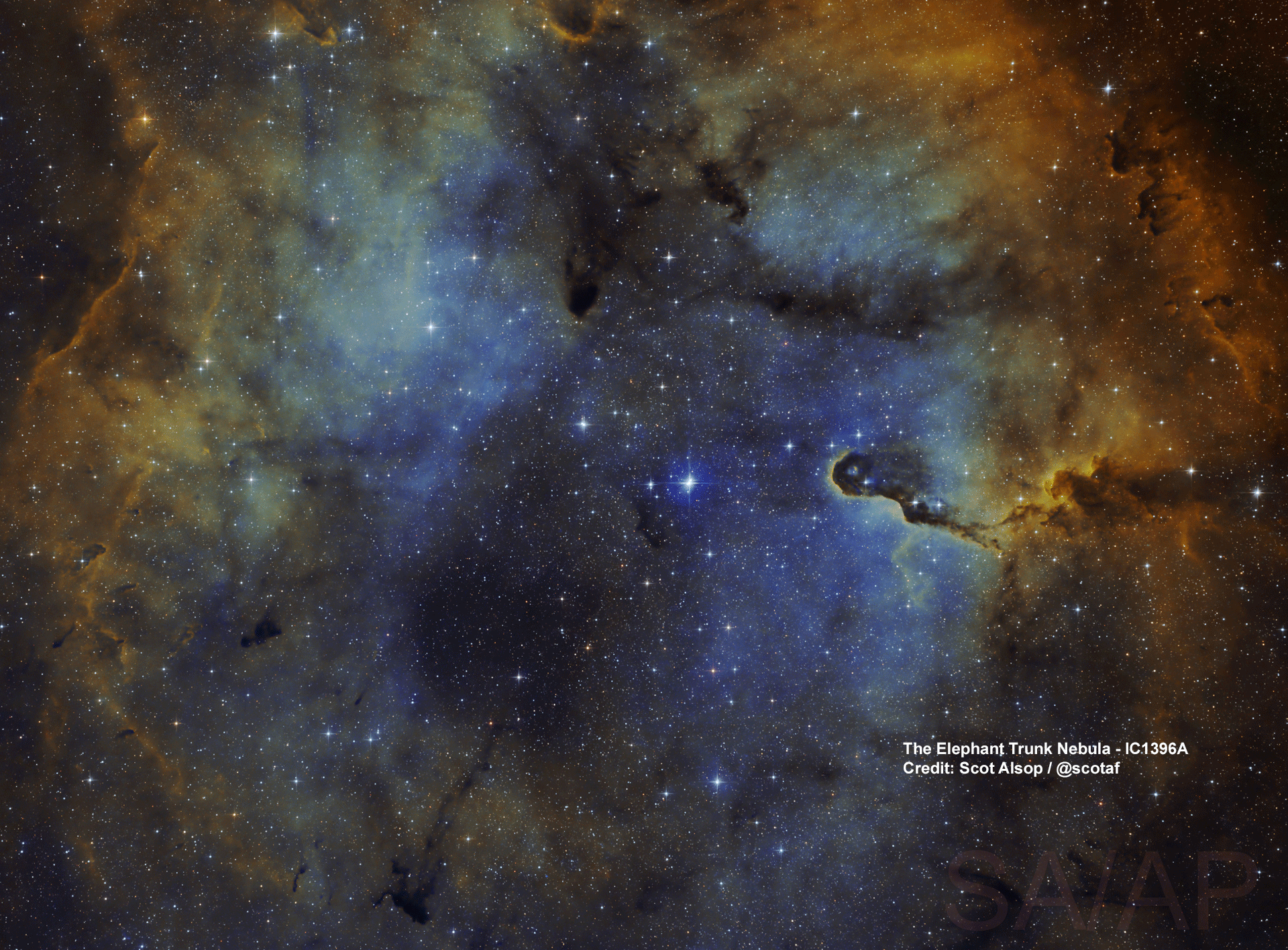
But what Imagers love most is when others look at their pictures! That’s why most post their work to various websites. Here we’ve collected a list below of some of our ASIG members image sites for your (and their) enjoyment.
Learn About Star Parties
Public Star Parties are held so that we can share our telescopes with anyone who wishes to attend. Since star parties are held at night in the dark, a few common courtesies will go a long way to making sure that everyone has a good time and a safe time.
RCA has a long tradition of small observing parties — it’s part of why the club was formed. RCA Club star parties are for members and their families and guests invited by members. The purpose is have a smaller, quieter event where attendees can spend an entire night observing or imaging without interruption. They are often in remote rural areas where conditions can be primitive at best.
The purpose of this Code of Conduct is to help insure your safety and the safety of others, to contribute to the enjoyment of club events, and to foster an atmosphere that will encourage other people to join RCA. These standards of behavior apply to club events, public events and at any volunteer or outreach events.


